
By Georgia de Havenon
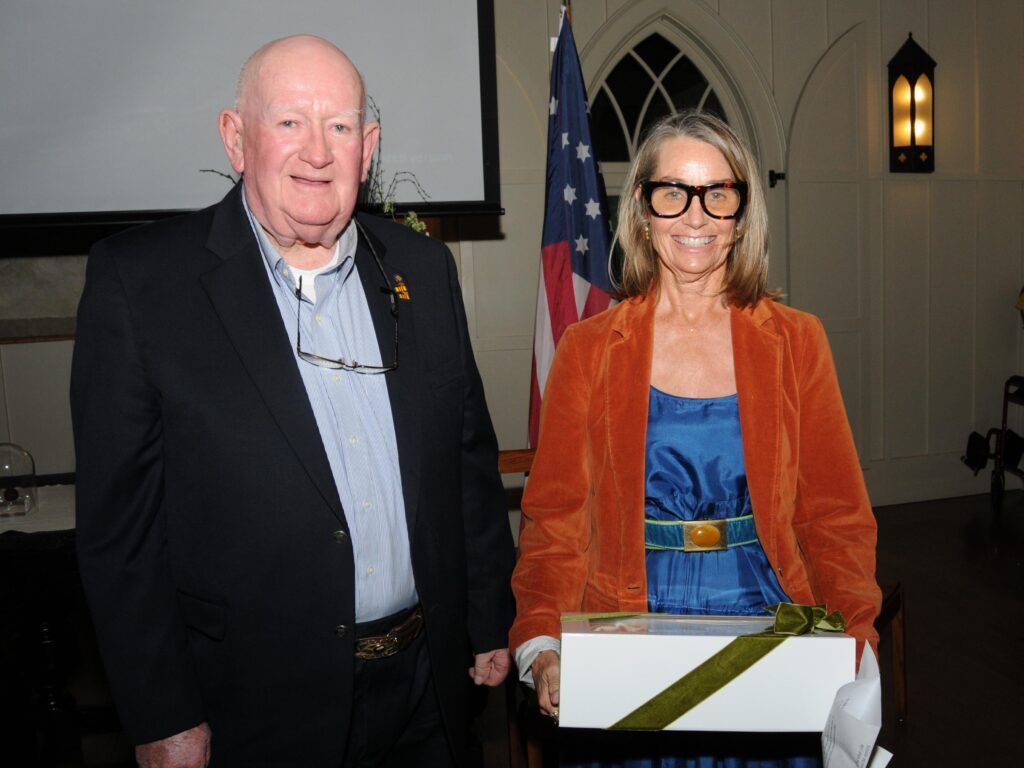
A goal of the Village Preservation Society of East Hampton is to elevate the public’s understanding and appreciation of local historic restoration projects undertaken by individuals, public entities, the government and most recently businesses and to acknowledge the magnitude of the enterprise required to preserve the precious touchstones of the Village’s historic character. These projects are not only remarkable examples of ingenuity and craftsmanship, but are gifts to the community at large, anchoring our heritage in the buildings that have graced our special landscape for nearly four centuries.
This year’s awardees were in two categories.
In the Residential category the award was presented to Lynn Douglass for her extraordinary renovation of the 111 Egypt Lane mid-eighteenth century Osborn House better known as “Rowdy Hall”, from which the Amagansett restaurant took its name. The project was undertaken by Erica Broberg, architect, Fifth & Dune, contractors, Paul DiLandro, structural and civil engineer and Guy David, house mover. Restoration of this historic timber frame structure in which a section of the foundation was sunk 6 inches into the ground, was truly a labor of love as well as a great gift to the Village of East Hampton. This home is one of East Hampton’s oldest and rarest dwelling types, and its survival in such an authentic condition is extraordinary. Originally owned by a member of the Osborn family and located on Main Street at the corner of David’s Lane, the home subsequently became the property of Deacon David Huntting, whose adopted daughter, Annie, in 1891, turned it into a boarding house frequented by young Bohemian artists. Hence, it became known as “Rowdy Hall”. It was relocated to Gay Lane and then in 1926, Mrs. Harry Hamlin purchased the house and moved it to its present location. At that time the noted architect Joseph Greenleaf Thorpe was hired to sensitively renovate the structure. Mrs. Douglass has respected the building’s historical integrity, authenticity, and importance to the history of the Village. Aspects of the renovation included reconditioning hand-hewn beams, original fireplaces and mantels, historic window glass, original moldings and original flooring, resulting in a highly livable as well as historic home.
Architect, Erica Broberg, gave a presentation that pictured and explained the complexity of the project, as the building had been moved to Egypt Lane and placed right on the ground. Photos depicting the raising of the house, the engineering involved and the precarity of a number of the efforts helped to illustrate the intense dedication and ability to problem solve this work entailed.
We were pleased to make the award in the Commercial category to Kevin Warren, President of Fifth & Dune for the expertly restored Dr. J. Finley Bell house, 1895, at 10 Pantigo Road, presently the offices of the construction company. This is a prime example of constructive re-use of an historic property that may otherwise have been lost. Elected to the New York Academy of Medicine in 1889 for his studies in bacteriology, Dr. J. Finley Bell practiced in East Hampton from 1890 to 1901. It was during this time that he had this house built, choosing self-taught local architect and builder, George A. Eldrege for the job. Eldrege’s work was well-known at that time as he was responsible for numerous shingle-style houses built in East Hampton in the 1880s and 90s. As the East Hampton Star observed in 1901, “Our local builders are competent to design and erect cottages that will compare favorably with houses fashioned by New York architects.”
We are grateful to these residents whose dedication to the community manifests in these beautiful old buildings that help to preserve our historic
character and become symbols of real civic pride.