
By Jaine Mehring
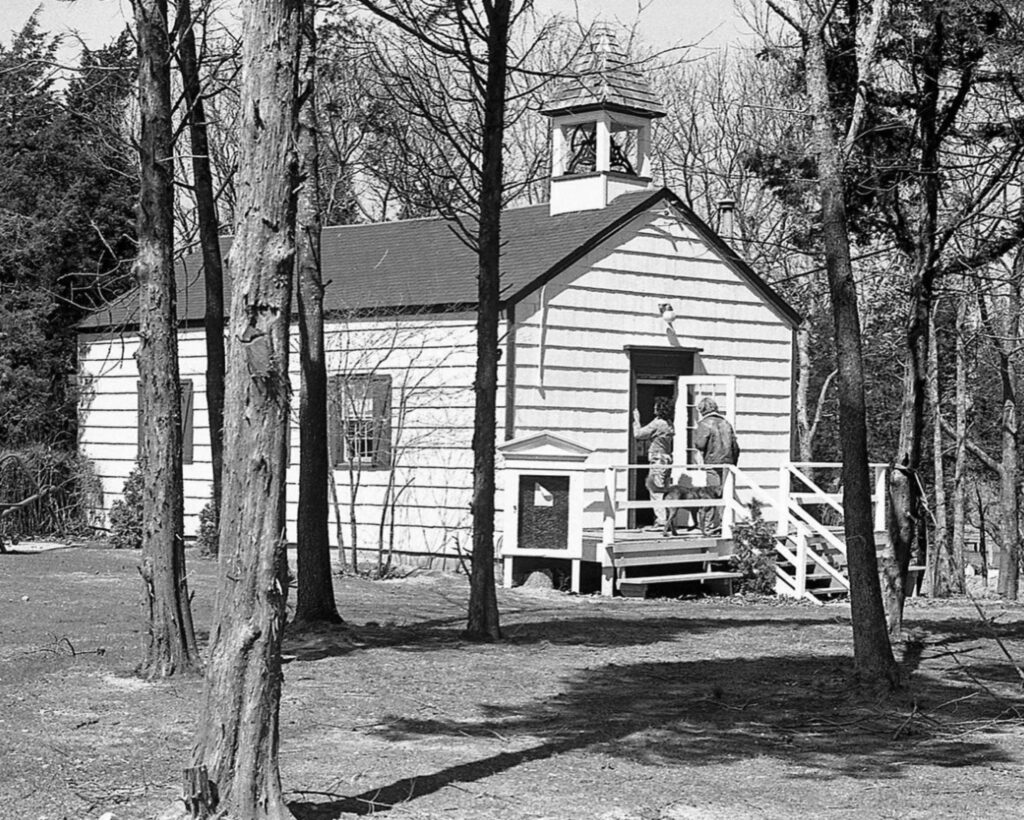
The Freetown St. Matthew’s Chapel was built in 1852 as a place of worship for three diverse cultural groups including White settlers, newly freed Black slaves and displaced indigenous Montaukett Indians, who lived in Freetown, just north of North Main St and worked in the Village and Town.
For over a century, St. Matthew’s Chapel was used for Sunday services, baptisms, weddings, funerals and Photo Credit: The East Hampton Star, Cal Norris Archive meetings. More than a place of worship, it was a focal point of the Freetown community. After the African American members of the Chapel left to build their own Calvary Baptist Church in 1958, many other members dispersed to other houses of worship within East Hampton, especially East Hampton Presbyterian Church and St. Luke’s Episcopal Church.
The small Freetown Chapel was in desperate need of repair, heated only by a pot belly stove in winter. Ultimately, the parcel was sold, leaving the Chapel vulnerable to demolition by the new owner. In 1976, to save the Chapel from demolition, Richard Sage, then-owner of the Maidstone Marina, bought the Chapel for $500 and moved it to the Maidstone Marina at Three Mile Harbor Hog Creek Road, now known as East Hampton Point Resort and Marina.
Under the care of Richard Sage and then, Ben Krupinski, the Chapel was well maintained and the historic elements and structure protected. Mr. Krupinski expressed a desire to return the Chapel to the Town to further its protection, but after his untimely death in 2018, East Hampton Point was sold to hedge-fund owner Heath Freeman and a group of private investors. The Chapel is presently used as a small ‘fitness center’ for the Resort’s guests.
In 2024, Preservation Long Island (PLI) issued a Letter of Recommendation enthusiastically supporting Local Landmark Designation Status. Although the interior has been altered somewhat for the present use, PLI finds that the historic integrity of the structure remains intact and the Chapel
“…meets and exceeds several criteria for designation as a local landmark under the Town’s preservation code.”
A group of local historic preservation groups, including VPSEH, met earlier this year to demonstrate support for a Town effort to designate this important historic and cultural asset as a landmark through the regulatory process available through the Town Code. Further efforts to potentially return the building to the Freetown area might also be explored, as it was a desire of the late Mr. Krupinski, who grew up in the Freetown area, to see the building moved back to its more historically accurate, original neighborhood.